

Trade Idea: Short HSI via Put Warrants ahead of September FOMC risk
Trade Structure – Buy out-of-the-money HSI put warrants to capture a potential downside move while keeping the maximum loss limited to the initial premium paid
Preferred Instrument – 16498 SG HSI Put, HK$24,000 strike, Feb 2027 expiry, ~8.9x
- At ~8.9x effective gearing, the warrant provides leveraged downside exposure to the HSI while retaining sufficient maturity for the higher-for-longer thesis to play out. The 24,000 strike is particularly attractive as it coincides with a key technical downside target, while the February 2027 expiry provides substantially more runway for the trade to play out and reduces the risk that theta decay erodes the position.
Indicative pricing (16498, as of 7 Sep 2026):
- Underlying = Hang Seng Index
- Strike = 24,000
- Expiry = 25 Feb 2027
- HSI moneyness = 6.4% OTM
- Effective gearing = 8.9x
- Delta = 28.3%
- Implied volatility = 23.91%
- Daily theta = -0.58%
- Breakeven price = 23,184
Investment Thesis
The case for US rates remaining higher for longer has now strengthened heading into the September FOMC (15th-16th Sep).
(1) A stronger-than-expected US August jobs report, (2) a hawkish tone from Fed Chair Kevin Warsh at Jackson Hole, and (3) recent renewed US-Iran tensions pushing oil prices sharply higher have collectively raised the risk that inflation remains more persistent than previously expected. Markets are now pricing a materially higher probability of a September rate hike, with UBS recently forecasting two new 0.25pp Fed hikes in 2026: one at the September FOMC meeting and another at the December FOMC meeting.
Three developments are particularly important:
(1) Resilient US labour market: August non-farm payrolls increased by 162,000, above expectations, while unemployment remained at 4.1%. The strength of the labour market reduces the urgency for the Fed to ease policy and gives policymakers greater scope to keep rates elevated if inflation remains sticky.
(2) Hawkish messaging from Fed Chair: At Jackson Hole, Kevin Warsh delivered a series of hawkish observations, highlighting that the Fed’s target remains 2.0% PCE inflation, rather than CPI or trimmed-mean measures, both of which are lower. In his assessment, inflation remains too high by any measure, reinforcing the Fed’s focus on bringing inflation firmly back to target. The remarks were interpreted as leaving the door open to further tightening should inflation not improve sufficiently, strengthening the case for a higher-for-longer US rates environment.
(3) Renewed US-Iran tensions and higher oil prices: Escalating tensions around the Strait of Hormuz have pushed Brent crude toward US$100/bbl, raising concerns about another energy-driven inflation shock. Higher oil prices could feed through into headline inflation and inflation expectations, making it more difficult for the Fed to cut rates aggressively.
Why is this bearish for the HSI?
If US interest rates remain higher for longer, Hong Kong equities face a structurally challenging macro backdrop. The key transmission mechanism is the HKD-USD peg. With Hong Kong's currency linked to the USD, Hong Kong monetary conditions broadly track those in the US. When US rates remain elevated, Hong Kong rates face corresponding upward pressure, limiting the HKMA's ability to ease independently without putting pressure on the currency regime.
This then creates three key headwinds for the HSI:
- Higher borrowing costs: Elevated HIBOR and local interest rates increase mortgage and financing costs, weighing particularly heavily on Hong Kong's property sector.
- Pressure on leveraged corporates: Higher funding costs and weaker domestic demand can squeeze earnings of highly leveraged property developers and conglomerates, which represent a meaningful component of the HSI.
- Weaker equity flows: Persistently attractive US treasury yields increase the opportunity cost of holding Hong Kong equities, potentially encouraging international capital to flock to USD and US treasuries rather than rotate into other risk assets, including Hong Kong equities.
We therefore see the September FOMC and the broader higher-for-longer US rates narrative as a potential catalyst for a further downside move in the HSI.
Payoffs
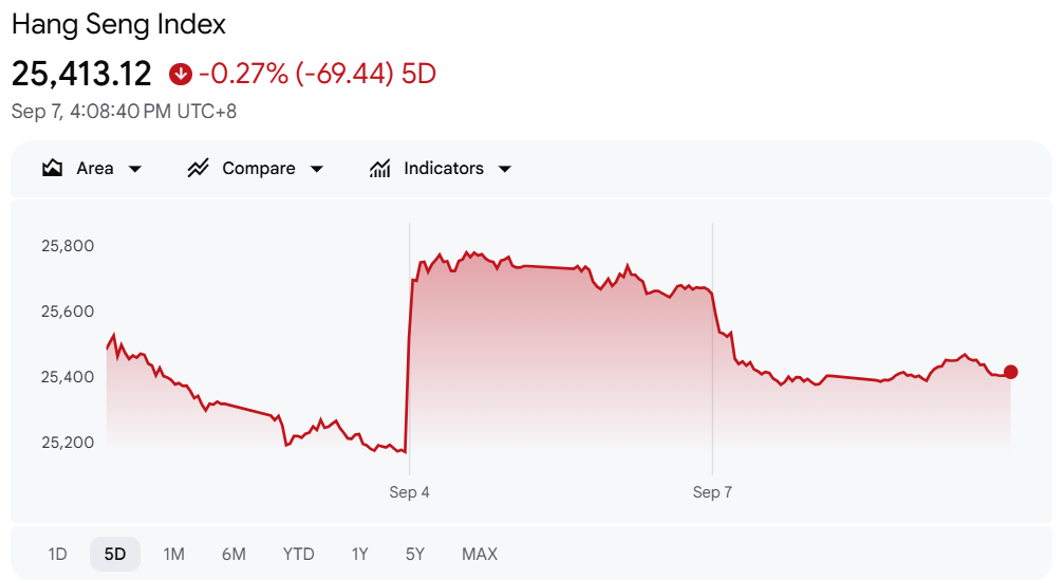
If the HSI declines from 25,413.12 (as of 7 Sep 2026) to ~24,100, a fall of roughly 5%, the warrant with 8.9x effective gearing could potentially generate around 45% upside, although the actual return will depend on changes in delta, implied vol, and time decay which affects the effective gearing.
- A deeper 10% HSI correction – ~90%+ profit: If the HSI falls from ~25,413.12 to ~22,800, a ~10% decline, a warrant with ~8.9x effective gearing could potentially generate ~90%+ upside, subject to changes in delta, implied volatility and time decay.
- Maximum loss – 100% of premium: If the HSI does not decline sufficiently and the warrant expires worthless, the maximum loss is limited to the initial premium paid, providing a clearly defined downside.
With a warrant, the key attraction is the asymmetric payoff: The maximum loss is limited to the premium paid, while a sharp HSI sell-off can generate significant returns using leverage.
Key Risks
Conversely, the trade would be challenged if US rates fall materially faster than expected, prompting expectations of Hong Kong monetary easing and renewed capital inflows into Asian equities. A sustained HSI move above the 26,000 area would also weaken the near-term bearish setup.
Bottom Line
We see a compelling asymmetric setup to short the HSI via put warrants, with a higher-for-longer US rates backdrop providing the catalyst and downside risk capped at the premium paid.
The key upcoming data point to watch is US August CPI on 11 Sep 2026, where a hotter-than-expected inflation print would reinforce the higher-for-longer rates narrative and support the trade, while a more benign reading would weaken the thesis and increase the risk of a reversal.


